 Official Louisiana State Websites use .la.gov
  Secure .gov websites use HTTPS

Ambient Air Monitoring Program
AMBIENT AIR MONITORING OPERATIONS
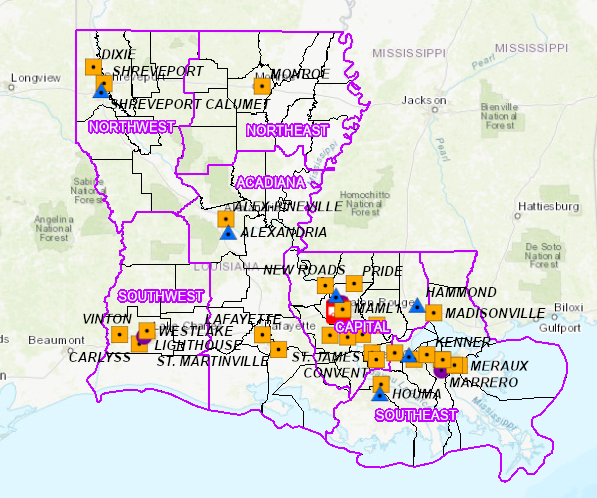
Ambient air monitoring operations are the responsibility of the DEQ Air Planning and Assessment Division's Air Field Services Section. Air Field Services (AFS) maintains a statewide monitoring network made up of stationary ambient air monitoring stations. From these sites, analysis personnel collect direct measurements of air pollutant concentrations then analyze and interpret the data. The data collected is used to track trends in air quality and determine compliance with National Ambient Air Quality Standards (NAAQS).
Monitoring sites contain specialized instruments to measure concentrations of the pollutants ozone, sulfur dioxide, nitrogen dioxide, carbon monoxide, lead, and respirable particulate matter, in accordance with federal air monitoring requirements. The Air Field Services Section also measures concentrations of volatile organic compounds at selected sites throughout Louisiana.
The AFS section also reports daily Air Quality Forecasts and readings to the public in the following areas: Baton Rouge, Alexandria, Lafayette, Lake Charles, Monroe, New Orleans, Shreveport, and Thibodaux. DEQ provides this information to radio and television news and local newspapers, who report the air quality reading in a short statement included in the daily weather report, mainly during ozone season. Hourly air quality readings and the daily Air Quality Forecast are also available on this web site.

Air monitoring data can be vewed in real time. The data is displayed based on pollutant type, current concentration, and location across the state and is updated every hour.
MAML
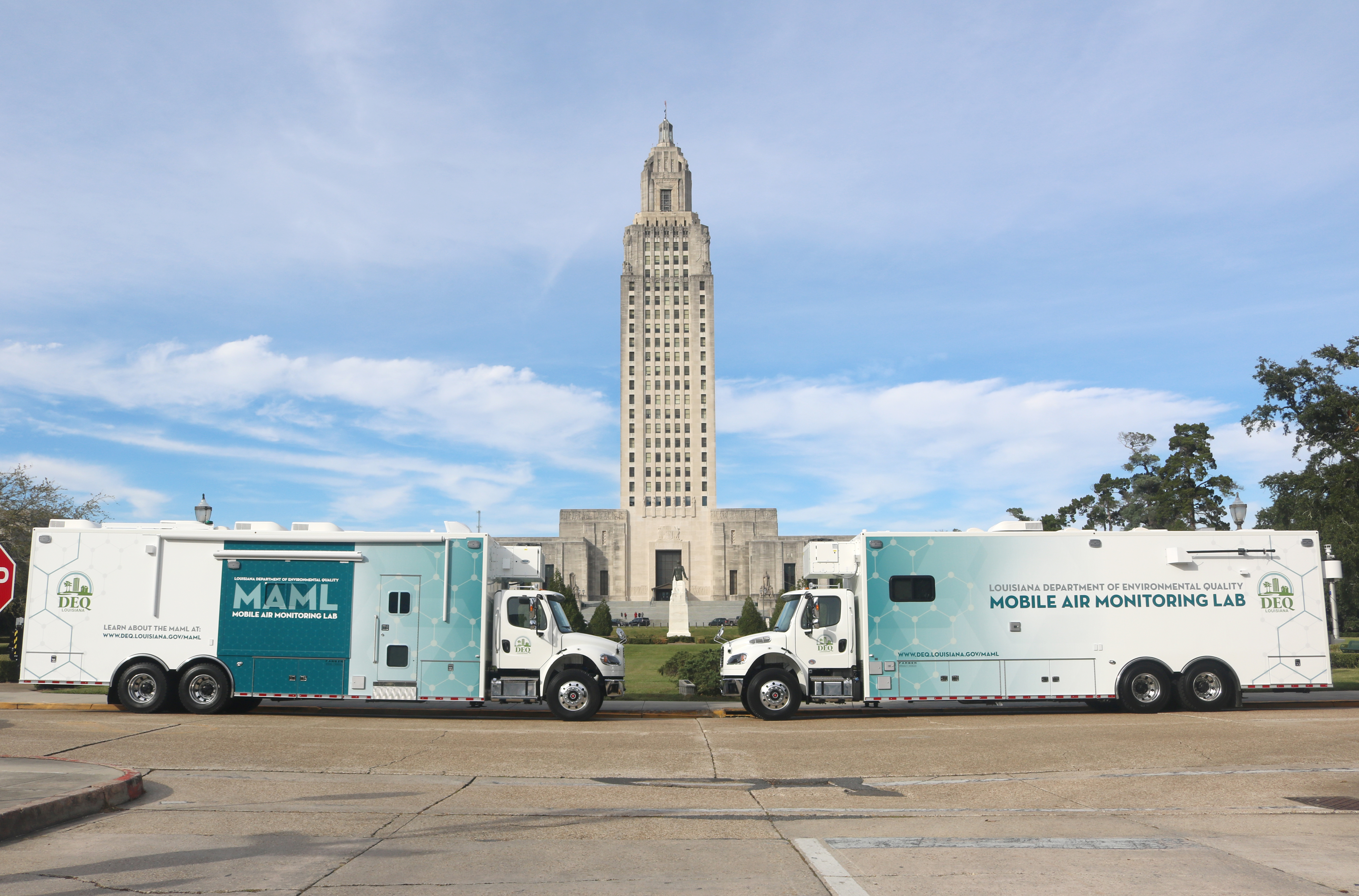
In addition to the stationary, ambient air monitoring sites, our department also has a Mobile Air Monitoring Lab (MAML). This is a "lab on wheels" that can be transported to different locations so that real-time air data can be collected in places that might not normally be monitored otherwise. The MAML can be deployed when an environmentally hazardous incident occurs, and a report is typically distributed to the public afterwards, documenting relevant results about the air quality.
NATIONAL AMBIENT AIR QUALITY STANDARDS
| Pollutant | Primary / Secondary | Averaging Time | Level | Form | Attainment Status |
|---|---|---|---|---|---|
| Carbon Monoxide |
Primary |
8 - hour 1 - hour |
9ppm 35 ppm |
Not to be exceeded more than once per year | Attainment |
| Lead | Primary and Secondary | Rolling 3 month average | 0.15 µg/m3 | Not to be exceeded | Attainment |
|
Nitrogen Dioxide |
Primary Primary and Secondary |
1 - hour Annual |
100 ppb 53 ppb |
98th percentile, averaged over 3 years Annual Mean |
Attainment |
| Ozone |
Primary and Secondary |
8 - hour |
0.070 ppm |
Annual fourth-highest daily maximum 8-hour concentration averaged over 3 years |
Attainment |
|
Particle Pollution PM2.5 |
Primary Secondary
Primary and Secondary |
Annual
24-hour |
9.0 µg/m3 12.0 µg/m3
35.0 µg/m3 |
Annual Mean averaged over three years
98th percentile, averaged over three years |
Attainment |
| Particle Pollution PM10 |
Primary and Secondary |
24 - hour |
150 µg/m3 |
Not to be exceeded more than once per year on average over three years |
Attainment |
|
Sulfur Dioxide |
Primary
Secondary |
1 - hour
3 - hour |
75 ppb
0.5 ppm |
99th percentile of 1-hour daily maximum concentrations averaged over three years
Not to be exceeded more than once per year |
Non-Attainment for St. Bernard Parish only |